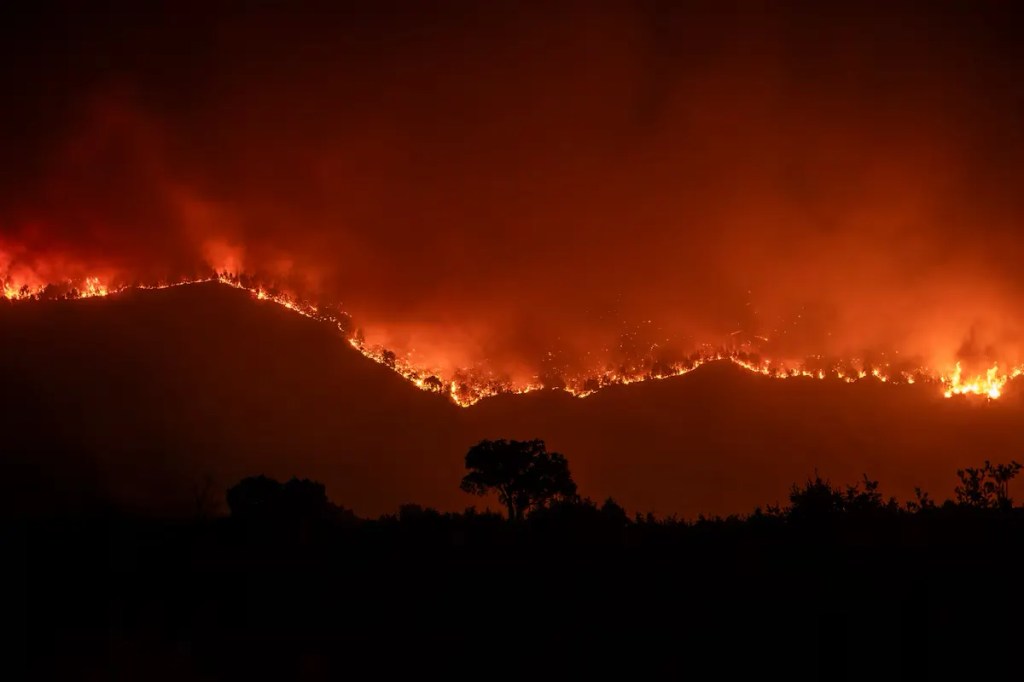
I recently had a surreal experience in Spain: finding myself in the middle of historically unprecedented wildfires on the Iberian Peninsula. This is a crisis globally which requires immediate attention across different fronts. In this note, I’d like to share some thoughts
Overview
Wildfires are no longer seasonal events. They have evolved into a year-round, multi-regional risk that is accelerating in both frequency and impact. This is inline with how most of other natural disasters are evolving. This crisis is the result of converging forces: 1) climate change, 2) poor policies, execution, and management, and 3) bad actors
Scientific forecasts are sobering. Without significant change, wildfire-related damages will escalate sharply over the coming decades. This is not simply a climate story. Political decisions, social behavior, land management practices, and development patterns all play critical roles. Solutions will require coordinated, cross-sectoral action that moves from reactive response to long-term resilience.
1. Wildfires are escalating across geographies and seasons
Anecdotal experience is aligning with global data. In Spain, wildfires on the Iberian Peninsula reached historically unprecedented levels. Similar trends are now visible across North and South America, Southern Europe, parts of Asia, and increasingly, regions previously seen as immune.
- In the United States, what was once called “fire season” is now a permanent condition in many Western states.
- In Canada, recent fire seasons are already six to ten times more likely than a century ago.
- Across Southern Europe, burned area could grow by 5 to 50 percent per decade under high-emission scenarios.
- Globally, extreme wildfire events are expected to rise by 30 percent by 2050, and by 50 percent by the end of the century.
- The Iberian wildfires of 2025, driven by record-setting temperatures and wind patterns, are now estimated to be 40 times more likely than under pre-industrial conditions.
The implications are structural. Wildfires are reshaping how societies plan cities, insure property, manage ecosystems, and prepare emergency services.
2. Four forces are driving the crisis
This crisis is not driven by a single factor. Instead, four interdependent drivers are compounding the severity of modern wildfires.
A. Fuel: Mismanaged landscapes and forest policies
Many ecosystems now contain far more combustible material than they did historically. Deforestation, abandonment of rural land, suppression of natural fire cycles, and insufficient investment in vegetation management have created highly volatile environments. In regions like the Amazon, fires are often deliberately set to clear land, and the ecological consequences are enormous.
B. Heat: Climate volatility and rising temperatures
Longer, hotter, and drier periods are intensifying baseline fire conditions. Average temperatures are rising across most regions, with fire-conducive weather events now recurring at shorter intervals. The interaction between extreme heat, wind, and low humidity is producing fires that are larger, faster, and harder to contain.
C. Sparks: More ignition points from humans and nature
The number of ignition events is increasing. Human activity (from power lines and equipment failure to arson and recreation) is a major contributor. At the same time, lightning-related ignitions are projected to rise significantly as climate shifts increase atmospheric instability.
D. Exposure: Expanding human presence in fire-prone areas
Population growth and urban expansion into the wildland-urban interface (WUI) are putting more lives, homes, and infrastructure in harm’s way. As development accelerates, especially in high-risk zones, the potential cost of fire rises in tandem. In the United States alone, over $12 trillion in property is now estimated to be at high or moderate risk from severe weather, including wildfire.
3. Future projections indicate rising economic and social costs
Wildfires are not only an environmental or safety issue. They are an economic challenge with long-term implications for public finance, insurance markets, workforce productivity, and healthcare systems.
- In California, wildfire smoke-related damages have been estimated at nearly $150 billion, equivalent to 1.5 percent of state GDP.
- In the United States, direct property risk from wildfires could exceed $11 billion annually by 2050 and over $45 billion by the end of the century in high-emission scenarios.
- Globally, the World Meteorological Organization warns that governments are not structurally prepared for a 50 percent increase in extreme wildfire events.
- The social toll is rising rapidly. Displacement, insurance withdrawal, respiratory illness, and loss of biodiversity are now critical dimensions of the crisis.
4. Addressing the crisis requires a multi-dimensional strategy
The evolving nature of wildfire risk means that short-term firefighting must be matched with long-term system change. Leaders in government, industry, and civil society should align around five areas of action.
A. Climate mitigation
Reforming land use, and accelerating investment in climate resilience are needed. Integrating wildfire metrics into national adaptation plans can improve prioritization.
B. Vegetation and land management
Prescribed burns, reforestation, grazing strategies, and forest thinning are effective in reducing fuel loads. Policymakers should fund science-based land stewardship programs and expand training for controlled fire practitioners. In high-risk regions, modernizing land-use policy is equally critical.
C. Resilient urban planning
Urban design must adapt to fire conditions. This includes zoning that limits WUI development, stricter building codes, defensible space regulations, and enhanced evacuation infrastructure. Insurance markets can support these efforts by pricing risk more accurately and rewarding mitigation.
D. Technology and early detection
Emerging tools in satellite imaging, artificial intelligence, and predictive analytics are improving early-warning capabilities. New models are demonstrating over 95 percent accuracy in forecasting risk zones and fire spread, enabling more agile responses. Investment in innovation should be a shared public-private priority.
E. Governance reform and cross-border coordination
Wildfires do not respect borders. Yet funding, planning, and emergency management often operate in isolation. Integrated governance models that link environmental, health, infrastructure, and disaster response systems are essential. Shared intelligence, interoperable data systems, and regional contingency planning can improve outcomes.
Final Thoughts: The new rules of risk
The wildfire crisis is a global wake-up call. It is no longer feasible to treat fires as natural disasters alone. The system has changed. Fire is now a strategic risk that intersects with climate, politics, economics, and public health. Wildfires are not only about forests burning. They are about the future we are building and the systems we are willing to reform. As the boundaries of fire expand, so must the ambition of our response.
Leo Komeily, Sept 8, 2025
